
The Algorithmic Agora: Access, Algorithms, and the Risk of Letting Minors In
Newsletter · Article 2

In Article 1, I described Brazil’s recent Decreto nº 12.975 of 2026 as a further move toward treating social media platforms as infrastructure.
A Brazilian Decreto is something like an Executive Order, in case you are wondering.
That framing adopted by Brazil recently matters, but it leaves a harder question unresolved: infrastructure for whom, and on what terms?
Decreto nº 12.975 of 2026 was adopted at the same time Brazilian President Lula signed another Decreto (numbered 12.976) for online protection of women.
So there are non-identical twin Decretos adopted by Brazil and which are on top of another law, the ECA Digital, a federal statute in Brazil aimed at protecting minors (Law No. 15,211/2025), all recently adopted and made effective.
The ECA Digital entered into force in March 2026 in Brazil, while some countries have chosen to ban access of children and younger teens altogether, at least in principle like Australia.
The reality is that minors are entering a space where the rules of engagement are written not just by legislators, but by algorithms, which are not neutral.
The Agora Reconsidered
Università Bocconi’s Professor Pollicino reminded me of the meaning of agora in 2025. The last time I had heard about agora was in the 1990s, as an undegraduate and then graduate student of law.
The classical agora (from the Greek) was a place of public assembly, commerce, and political speech. It was open, in the sense that it was physically accessible to those who happened to live nearby. But it was not free in any universal sense: access was conditional, participation was shaped by power, and what got amplified depended on who held the floor.
Social media is often described using a similar vocabulary of openness, a “global public square”, a space for the free exchange of ideas (or new marketplace of ideas, to borrow from Professor Pollicino’s lectures).
The metaphor is flattering to the platforms. But unlike the agora, where the rules of participation were at least visible and debatable, social media operates under an additional layer of mediation that is neither transparent nor neutral, and that is the recommendation algorithm.
The algorithm does much more than merely organising what WE see. It selects, weights, sequences, and AMPLIFIES. It learns from our behaviour, from what we pause on, click, share, and avoid, and then the algorithm optimises for engagement. More time on platform equals more data equals more advertising revenue, which is partly split with eligible influencers, in a cycle which may be vicious. The algorithm is designed to keep us there. It is not designed to make us informed or well. We get hooked up.
This is now under strict scrutiny, particularly in 2026 when some social media platforms were found by juries in the U.S. to have been negligent. See a press report on two of the cases (from California and New Mexico) here.
Who Are We Talking About?
In 2025 Brazil disclosed results of a census showing a resident population of more than 213 Million people. That is not inclusive of Brazilians living outside of Brazil, whether on a permanent or temporary basis.
Brazil’s population aged 14 or older was approximately 175 million in the first quarter of 2026, which should mean Brazil could have 38 million children and adolescents.
Households with access to the Internet in 2024 were almost 75 million, according to Brazil’s IBGE. I will assume that mobile access is included.
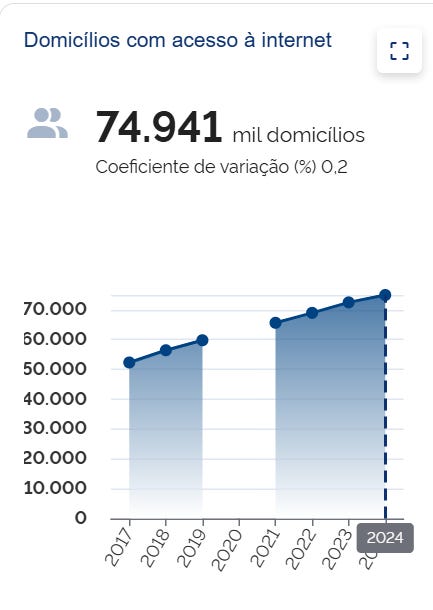
Regardless of much, potentially tens of millions of children and adolescents in Brazil have some sort of Internet access and social media presence or exposure to it.
The ECA Digital does refer to probable access to technology products or services by children and teenagers, and it it actually defines with probable access is in the beginning of its text, which includes 41 sections.
Probable access to technology products in the ECA Digital specifically includes access to “products or services which are aimed at allowing social interaction and large scale sharing of information among users in a digital environment” (free translation). Long way to refer to social media, but there it is, and it also expressly refers to significant risk to privacy, safety and biopsicosocial development of children and adolescents.
Social media is also part of a whole chapter of the ECA Digital. Click on the picture below for the text of the ECA Digital as it is found in the Brazilian Federal Government database in Portuguese, if you are interested.

The ECA Digital requires platforms to tie social media accounts of under 16 teenagers and children social to a legal guardian’s account.
And there are some proactive measures which social media platforms must take in Brazil to protect under 16s, including explanation in a clear, highlighted and accessible way of those services which are inappropriate. Tricky balance for the platforms to define what is and what is not inappropriate, and risky too, but the ECA Digital expressly refers to porn in its Article 9, Paragraph 2 (or any other illegal content, falling short or expressly referring to what those are).
Under the ECA Digital, platforms must also monitor and restrict content clearly aimed at attracting children and teenagers within the limits of their technical capacity. This sounds more like a best efforts obligation than a clear one, and it is subjective too, as limits are not clear in the text of the act, which is what the ECA Digital is.
Lastly, social media platforms are required under the ECA Digital to continuously improve their identification mechanisms, which takes us to the unresolved challenge of biometrics and all the privacy and other fundamental concerns which are totally fair there.
There is also a prohibition for profiling children and adolescents (including from the use of data on age verification) for targeted advertising.
A Cost-Benefit Frame
The benefits of access to social media by teenagers (more than children) may be and probably are real.
Social media is, for many Brazilian teenagers, a primary channel of civic participation, cultural expression, peer connection, and access to information.
For certain groups of adolescents in regions where their identities are stigmatised, online communities may be the only available source of social contact. For young people in under-resourced areas, it provides access to educational content, economic opportunity, and awareness of their rights.
Restricting access to these spaces has costs, which fall disproportionately on those who have less access to alternatives.
Ultimately, is the algorithm going to help or harm them?
Algorithmic transparency
The ECA Digital and the Decreto nº 12.975 together seem to form a more coherent regulatory layer than existed before. Taken together, they also seem to leave a significant gap.
At first glance, I do not see either of them addressing or addressing sufficiently the algorithmic infrastructure itself. Recommender systems are definitely not as regulated in Brazil as they are under the European Union Digital Services Act (e.g., under the DSA Article 27).
My reading of Article 27 of the DSA is that it goes further than transparency alone. The EU require Very Large Online Platforms to offer users at least one recommender system option that is not based on profiling, and to give users meaningful control over that choice.
The ECA Digital which is aimed at protecting minors in Brazil does not appear to contain an equivalent (i.e., no optionality, no user control lever). That is a meaningful gap.
In any event, requiring reports as the Decreto does for systemic risks is a step towards the right direction. Maybe too timid. And the ECA Digital also requires some reporting by larger platforms (i.e., 1 Million users), which may include aspects of the algorithmic infrastructure. But also maybe too timid.
For comparison, under the DSA in the EU, Articles 34 and 35 impose on Very Large Online Platforms a duty to conduct systemic risk assessments and to implement mitigation measures with a level of detail which I have not been able to find in writing in either the Decreto or the ECA Digital from Brazil.
As in the European Union and under the DSA, trade secrets of social media platforms are protected in Brazil, but maybe silence from the Executive and Legislative protects trade secrets even more in Brazil.
All this said, Brazil has adopted something interesting in the ECA Digital: under its Article 31 (sole paragraph) all internet service providers, including social media platforms, must provide free access to data for research on the impact of their products and services to the rights of children and teenagers not only to scientific organisations (as in the EU DSA, particularly its Article 40), but also journalistic organisations (for goals which are not commercial and under strict confidentiality precautions). That still needs to be further regulated in Brazil.
A Note on the Agora Metaphor
I want to return, briefly, to the agora because I think the metaphor holds, and holds better than its critics may allow.
The ancient agora was not a neutral space. It was shaped by the interests of those who controlled it, by the physical infrastructure of the city, and by the rules, formal and informal, about who could speak and be heard. What made it a public space was the fact that the constraints were, at least in principle, subject to collective deliberation and political challenge.
Social media platforms are the agora of our time in a similar sense: they are where speech happens, where political and cultural life is conducted, where identity is formed and contested. What makes them unlike the agora is that the constraints shaping participation (that is the algorithms) are not subject to collective deliberation. They are proprietary, opaque, and optimised for a commercial objective that may be systematically at odds with the public interest.
For minors in particular, who are entering this space at developmental stages where they are especially susceptible to social influence and algorithmic manipulation, the key question is whether the terms of that access make sense. A second question is whether the law, as it currently stands in Brazil, the EU or anywhere else, is demanding enough of the platforms that control those terms.
Brazil’s regulatory arc suggests a legislature and executive that understand the question. The answer is still being written.
Article 2 of an ongoing newsletter exploring comparative digital regulation.
Full disclaimer: the ideas are all mine and I had some help from Claude to develop the text, which I then revised.
As always, I am interested in views from this network, including from those working in child protection, platform governance, or digital inequality in Brazil and elsewhere.
Roberto di Cillo © 2026 · All rights reserved